Sunday, 2 February 2020

The Road Ahead for Peru

Manu National Park in Peru is over 1.5 million hectares in size. It is designated as a World Heritage Site and UNESCO has said that it has an "unrivalled variety of plant and animal species." Those include Spider monkeys, Emperor tamarinds, Ocelot, Jaguar and Puma.

Eilidh Munro is a self-taught photographer and filmmaker from Edinburgh. She spent many evenings and weekends building her portfolio by learning from other filmmakers and editors, all whilst working a day job in an advertising agency.
Eilidh Munro films in the rainforest.

The Film:
These worlds have now collided, as Munro has managed to put together a film called 'Voices on the Road' about the park - but this time it is about the people more than the animals.

"They have never been asked what life is like in the middle of the rainforest," says Munro of the people she interviewed while making the film. They have no clean water, no sewerage and no easy access to markets to sell produce and make a living.

The 23 minute film is the result of ten months of work, with journalist Bethan Jones and biologist Shirley Jennifer Serrano-Rojas. The work centres on the 'better life' that is promised by a controversial road through the middle of the National Park and adjacent Amarakaeri Communal Reserve.


The Road:
The road is intended to link all the isolated communities in the park, with the outside world. Although construction started in 2015, work on the road was stopped by the Peruvian Environment Ministry. Regional Governors argue that the road will help with wealth creation for the local tribes, when they can sell their produce in new markets. This, they say, will ultimately lead to people being able to clothe and educate their children, as well as gain other luxuries like internet access.

Edgar Morales Gomez, a District Mayor in the region says, "The road will bring water, communications, internet - so many things. Only with the road can we change our life."

Illegal work on the road continued despite the order to cease; loggers carried on by hand and the destruction of the forest continued pretty much unabated. Then, in November 2018, after a three year battle, construction of the road was approved again.

Other say the benefits have been over-hyped. There could end up being 40,000 hectares of deforestation, which could also have a fishbone effect (lots of smaller side roads being cut to join up with it), lead to more loggers moving in and the possibility of the smugglers setting up base.

The Expedition:
Funding of the film came from the Scientific Exploration Society, with an additional £15,000 raise via crowdfunding.

Munro and Serrano-Rojos undertook a 40-day expedition to visit four communities in the making of the film; Diamante, Isla de los Valles, Shintuya and Shipetiari. They interviewed the community leaders first and didn't film at all for the first few days, in order to be discreet and put the communities at ease.

The film (which has been shown at a variety of small film festivals, but has had no general release yet) captures how these people are feeling; some long for the promised profit the road might bring - while others fear the havoc and loss of culture that it might herald.

The Communities:
Poor Andean farmers were encouraged into Manu with cheap land from the state, to exploit untapped natural resources. They were encouraged to farm with the promise that they would prosper from agriculture as the road advanced - and this has not happened.

The communities of Shipetiari and Shintuya have both struggled, even with the road connection already made, as they are forced to sell their goods through intermediaries. In the case of Sintuya, there has been a road to them for 50-years, without any of the supposed benefits, but with additional pollution and deforestation.

They are also in danger of losing their customs - "[we are] trying to rescue our culture, our identity, our respect," says Victoria Crispera. It seems that the desperation of the people may have been used, with the promise of empowerment, but only politicians profiting from a black economy.
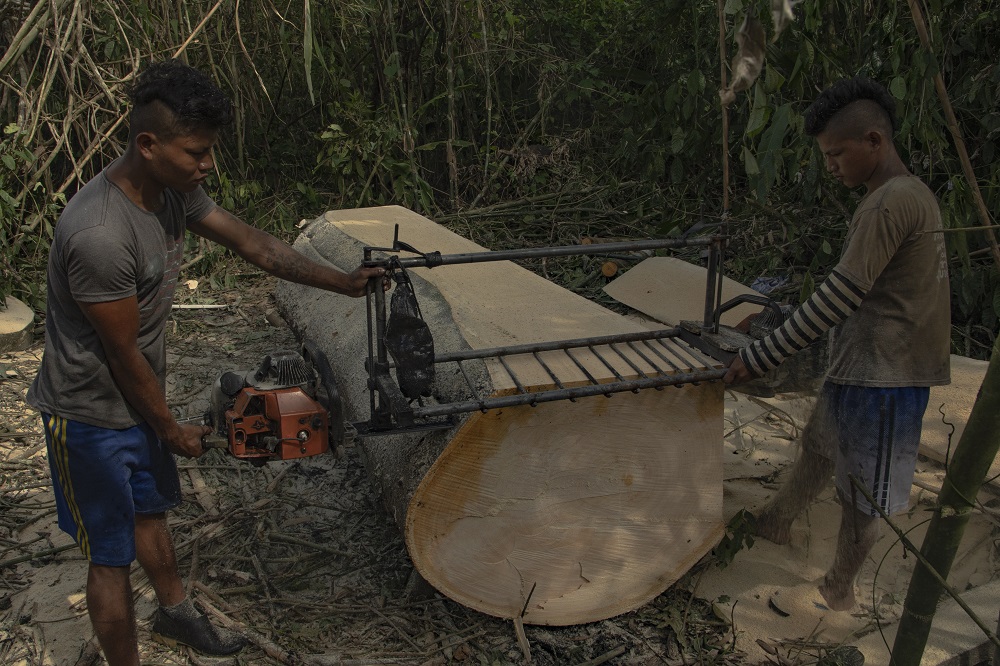
© Eilidh Munro / Bethan Jones

Luis Otsuka Salazar:
Luis Otsuka Salazar is a former regional governor: "Here I see this poverty that disgusts me!" But this may be lip-service of fake promises.

It is illegal in Peru to build a road for the purpose of exploring for gas and oil, and the road would appear to be bordering on that illegality. Otsuka used to be the President of Mining Federation of Madre de Dios (Federmin). In Madre de Dios, 90% of the gold mining there is illegal and modern slavery is rife, with trafficking of women and girls into sex work being common. The final destination of the road is pretty much the epicentre of this illegal gold mining area!

The advance of the road, technically illegal or otherwise, seems to be unstoppable. Cocaine is now the new cash crop here, although it is declining elsewhere, production of coca in Madre de Dios is up by 52%.

This is a frightening prospect for some. Waldir Gomez Zorrillo says, "They could make us accomplices. The army, when they catch you, they catch you innocently because they think you're working. They blame us, It's us who pay!"

But the road hasn't reached Diamante yet. For them the road remains a symbol of hope, as they have become so obsessed with the possibility that it will improve their lives, that they will overlook all of the other negative potential outcomes. Oscar Guadalupe Zevallos, a director of human rights organisation Asociacion Huarayes, says, “We have a state that doesn’t worry about the employment of people. They play with people’s natural desire; they sell us roads, but they don’t sell us development. How are we going to use this tool - the road - to improve the family economically, to improve the education of our children?”

Munro believes there is still hope; “There’s also a big movement which is proving that protecting indigenous land rights is by far the best way to protect the environment and there are recent examples of South American indigenous groups who have successfully sued governments for misleading them in discussions around construction on their indigenous land, so there are small steps being made."

You can watch the 'Voices on the Road' trailer here - and also check if there are any other screenings planned.

Research:
Transform magazine: 'A perilous road ahead' - December 2019
https://theecologist.org/2019/may/07/voices-road
https://www.voicesontheroadfilm.com/
https://www.sundaypost.com/fp/voices-on-the-road-scottish-filmmaker-explores-why-indigenous-communities-are-contributing-to-amazons-environmental-demise/

Monday, 13 January 2020

UK emissions already surpassing other countries!

An Oxfam report on 6th January highlighted the fact that the per capita emissions for the UK had already surpassed Rwanda's expected total for the whole year!

With UK citizens averaging over 8 tonnes of carbon emissions per year (2017 data), it only took us 5 days of the new year to surpass what Rwanda would expect to generate, per person, in an entire year. Beyond that, by the 12th of the month, we would have gone past the annual figures for Malawi, Ethiopia, Uganda, Madagascar, Guinea and Burkina Faso!

Oxfam-GB Chief Executive, Danny Sriskandarajah, said, "The sheer scale of global inequality when it comes to carbon emissions is staggering." This would appear to be borne out by a quick check of some of those 2017 figures;
  • UK - 8.34t per capita, per year
  • Rwanda - 0.09t per capita, per year
  • Burkina Faso - 0.25t per capita, per year
  • Nigeria - 0.49t per capita, per year
  • India - 1.68t per capita, per year
  • Global Average - 4.7t per capita, per yea
Oxfam commissioned a YouGov poll to find out more about what Britons feel on the subject, with the overall consensus that we are concerned, with many worried about climate change impacts and wanting to do more.
  • 79% said that they are more likely to recycle more
  • 38% said they might change their diet (e.g. less meat and dairy)
  • 2/3 said they use more energy efficient products and/or renewable energy providers
  • Around 1/2 said they are trying to limit their air travel
  • 61% say they want the government to do more to fight the climate emergency
That last one is always is a bit of a cop-out; yes, the government needs to be leading the way, but we all have a role to play and it will be consumer pressure that ultimately drives businesses to make the big everyday changes we need to see for meaningful change; ultimately it is us who decide when and where we travel, what type of energy we power our houses with and if we ethically / environmentally source our clothes.

"As the UK government gets ready to host global climate talks this year, it needs to show that it is deadly serious about leading the fight against climate change," says Sriskandarajah.

What does it really mean?
In actuality, despite this frightening statistic, the UK is actually only ranked 36th in the world for CO2 emissions per capita! So despite our average being almost twice the global average, there are still 35 more countries with worse per capita rates than us.

The Global Carbon Atlas - here - is a great tool to play around with if you have any interest, and where most of the statistics for the post have originated from.

18 of the 20 nations at the bottom of this list are in Africa, while the Top 3 looks like this;
  1. Luxembourg - 40t per capita
  2. Qatar - 30t per capita
  3. Trinidad & Tobago - 27t per capita
All of the top 25 on this list are averaging over 10 tonnes CO2 per capita! But you will notice that these three most 'troublesome' countries, are all tiny - so perhaps this metric is a little misleading?

Other charts:
So, let us look at some of the other ways in which they measure emissions, and see if that helps give a slightly more realistic perspective.

When measured against GDP (Gross Domestic Product), the list changes, but perhaps not how you may expect. The Top 10 in this list now has 3 Asian countries (Kyrgyzstan, Mongolia, Kazakhstan), 4 from Africa (Togo, South Africa, Mozambique, Botswana), 2 from Europe (Ukraine, Estonia) and only 1 from North America (and that is Trinidad again, in the Caribbean, rather than the mainland).
  1. Trinidad & Tobago - 0.93 kgCO2/GDP
  2. Kyrgyzstan - 0.80 kgCOP2/GDP
  3. Ukraine - 0.71 kgCO2/GDP
The USA pops up at number 30, with a rate of 0.333 kgCO2/GDP - while the UK is way down at 80th position, with a rate of 0.21 kgCO2/GDP. In this set of (2017) data, there are over 100 countries with no data measured.

The GDP way balances emissions against how industrialised a country is becoming, so it is perhaps no surprise that it is largely what we would see as developing countries having high emissions measured against low, or growing, economies - whereas more (so-called) western nations have large economies to balance their emissions against (which also means they have the capacity to start carbon reduction programmes which may be viewed as more of a luxury in some nations).

The 'actual' truth:
So the last way to look at this, is perhaps the crudest - just plain old, straight up 'actual' emissions. What a country emits, regardless of how big it is, how much money it makes, or how many people live there.

This chart gives us a chart that perhaps makes more sense to what we know about the world - here are the Top 5 for 2017;
  1. China - 8549 mtCO2 (megatons)
  2. USA - 5687 mtCO2
  3. India - 2260 mtCO2
  4. Japan - 1393 mtCO2
  5. Russia - 1373 mtCO2
The UK sits at 12th in this list (557mt), which makes sense when judged against other countries we might view as being similar. Germany is sixth (895mt) and France 17th (459mt); emerging nation, Brazil, is 14th at 513mt.

When we now look at some of those nations on the other lists, through this window, we see a different picture.
  • Qatar - 47th - 82mt
  • Trinidad & Tobago - 66th - 37mt
  • Luxembourg - 73rd - 24mt
  • Kyrgyzstan - 88th - 16mt
The difficulty now is that developing nations want the 'luxuries' that fossil fuels brought the western world in the nineteenth and twentieth centuries - but because we now know the problems that brings, we are effectively telling them they can't have that! We need to find ways to try and give such countries the way of life they want, but in as sustainable a way as possible.


Research:
https://transform.iema.net/article/uk-emissions-already-outstrip-rwandas-annual-total-2020-oxfam?redirectcounter=1
http://www.globalcarbonatlas.org/en/CO2-emissions
https://www.independent.co.uk/environment/british-carbon-footprint-africa-emissions-oxfam-climate-change-a9271861.html
https://www.theguardian.com/environment/2020/jan/05/britain-annual-carbon-emissions-overtake-africa-two-weeks-oxfam

Tuesday, 17 December 2019

UK Farming and climate change

A bit more this time, on agriculture and the impact it has on climate change, and what the industry needs to do to do its bit in the UK.

Setting the scene:
UK farms are said to produce around 46.5m tCO2e in GHG (Greenhouse Gas) emissions each year; that is, around 10% of the total UK emissions. But additionally, we import around 48% of our food, so the carbon footprint from food production is probably much, much higher (and rising). A WWF-UK / Food Climate Resource Network report in 2010 said the actual UK footprint of farming could be more like 30%.

The relationship between farming and climate change has become somewhat fractious over the years. Farmers say that there is a distinct 'anti-meat' agenda out there, with Guy Smith, Deputy President of the NFU (National Farmers Union) saying, "The vegan lobby are hijacking the climate debate."

The politics can be quite confusing. The Conservative government of the 1990s, for example, told farmers that if they improved their standards, that people would be happy to pay a premium for that additional sustainability and welfare. A ban was put in place on sow stalls that restricted the movement of pregnant pigs - it was, the government said - what the consumer wanted. So farmers invested the money to overcome the law, but they were thwarted; there was no such restriction on imported pork and so that consumer support never happened, as people were happy to go for the cheaper (imported) option!

IPCC report:
The NFU, which represents 55,000 British farmers, says that the International Panel on Climate Change (IPCC) report on 'Change and Land', has been misinterpreted by many - and especially the BBC - they say, basically boiling it down to 'eat less meat and save the planet.' They point that the actual text of the report says;

"Balanced diets, featuring plant based foods, such as those based on coarse grains, legumes, fruit and vegetables, nuts and seeds, and animal sourced food produced in resilient, sustainable and low GHG emission systems, present major opportunities for adaptation and mitigation while generating significant co-benefits in terms of human health."


The industry claim that beef produced in western Europe, for example, is around 2.5 times more efficient in how carbon is managed than the global average.

This gets into another contentious issue. Beef production is the perceived bad boy of agriculture, in climate change terms, as it is a high producer of methane and nitrogen oxides - which are more damaging GHG's than CO2. While carbon dioxide takes a bit of a backseat in this discussion, scientists don't necessarily agree on the outcomes.

Methane was responsible for 56% of farming GHG emissions in 2017, and NO for 31%. This comes from the complexities of soil and microbial processes. The debate surrounds how much weighting they are given in the scientific outcomes. There are those who say that since they are the big GHG emitters, they must be weighted highly; the flip side is that their effects are easier to reverse, as they don't remain in the atmosphere as long, so the weighting should be lowered somewhat.

The NFU and the future:
The NFU vision, set out in September 2019, says that this 46.5m tonnes of emissions could be removed completely in the next 20 years. They say that;
  • More efficient production will remove 11.5m tonnes
  • Farmland as a store for carbon will remove 9m tonnes
  • A boost to renewables and bioenergy will account for a whopping 22m tonnes
On that last point, countryside online say that farmers have already diversified to renewables production, to the point where they provide power for 10 million homes.

The NFU say that if farmers are offered rewards, then this is all achievable.

But there has been no real progress on reducing farming emissions since 2008. A 2013 target to plant 5,000ha of trees a year has also proved difficult; in England in the year up to March 2019, only 1,420ha was planted (according to the Woodland Trust). Guy Smith says, "We are happy with trees on farmland as long as it doesn't significantly curtail production. [Otherwise] you'll just offshore the carbon and they will continue ripping down the Amazon rainforest."

Countryside Online say that in 2017 there were 35,000 agri-environmental schemes happening with farmers in England, all helping to protect the environment and enhance biodiversity. 

The dairy industry has produced a Dairy Roadmap for 2020 - 2025, setting environmental targets, such as around fertiliser use and hedgerow protections. They claim that GHG emissions from the UK dairy industry have been reduced by 24% since 1990, and that most farmers now undertake nutrient and manure management programmes to minimise water pollution.

The Royal Society for the encouraging of Arts, Manufacturing and Commerce (RSA) Food, Farming & Countryside Commission has a report out that says farming and food systems must be sustainable by 2030 to help with tackling climate change and meeting government targets.

They say meat must come from 'sustainable livestock', and reflect the NFU claim, that farmers could make these big changes over the next decade if they are given the right backing. 

One example would be agro-forestry, where trees are mixed with crop and grazing fields. One farmer engaged in this practice, Ben Raskin, says, "There's a lot of evidence that if an animal is sheltered it's more productive - so its' spending less energy keeping its core warm so it can put more energy into producing milk or putting on weight, which is good, obviously, for production on the farm."

The Wrap:
So, what we see is a need to strike a balance between the need for sustainability and putting in place measures to help reduce carbon emissions and combat climate change; whilst simultaneously dealing with the ever growing demand for cheap (or at least reasonably priced) food.

As with other industries facing the climate change conundrum, it will be a mix of innovation, legislation and willing participation that will lead to UK farming successfully reaching their targets (or otherwise).

Research:
'Out to pasture?' Transform magazine - November 2019
https://www.countrysideonline.co.uk/food-and-farming/protecting-the-environment/how-are-british-farmers-helping-to-tackle-climate-change/ 
https://news.sky.com/story/make-uk-farming-sustainable-to-help-save-the-planet-report-11763956